Muskoka cottage closing costs at a glance: the budget most buyers should plan before making an offer
Most buyers arrive at closing day underfunded — not because the purchase price surprised them, but because closing costs didn't fully register when they made the offer. In Muskoka, where purchase prices on waterfront properties regularly start in the high six figures and reach well into the millions, even a modest percentage adds up to a number that demands its own cash reserve.
The core categories you need to plan for before making an offer are:
- Land Transfer Tax (Ontario provincial, calculated on purchase price)
- Legal fees and disbursements
- Title insurance
- Home inspection fee
- Appraisal fee (required by most lenders)
- PST on CMHC mortgage insurance (if your mortgage is insured)
These are separate from your down payment. Your lawyer collects most of them on or just before closing day, but some — like the inspection and appraisal — get paid during your conditional period, well before the deal firms up. (Source: Cottage Country Mortgage)
A practical framework: most Muskoka buyers should hold back a meaningful cash reserve beyond their down payment to cover closing costs and early ownership expenses. The exact total depends on purchase price, mortgage type, and property complexity — which is why getting a real-number estimate before you make an offer matters more than a rough percentage rule. Budget conservatively, and confirm the specifics with your lawyer and mortgage professional as early in the process as possible. (Source: muskokacottageforsale.ca)
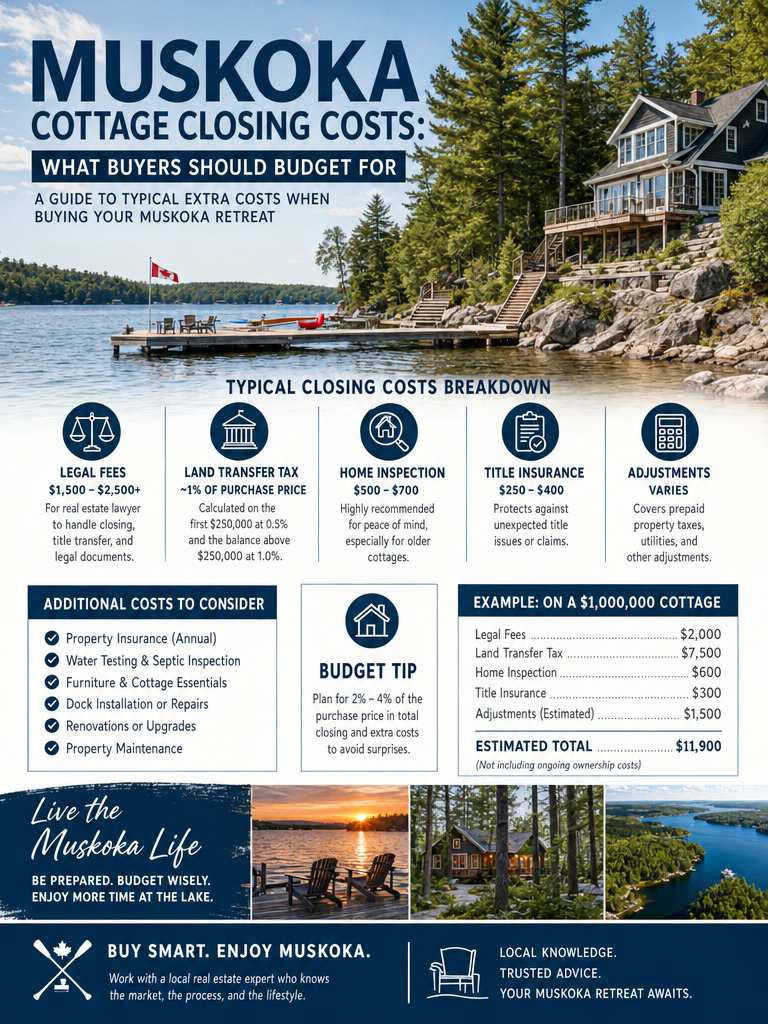
The main closing costs to expect on a Muskoka cottage purchase
Land Transfer Tax
Ontario's Land Transfer Tax (LTT) is calculated on a sliding scale based on the purchase price and is one of the largest single closing costs on a Muskoka property. Because Muskoka waterfront prices are well above provincial averages, buyers typically land in the higher tax brackets. First-time buyers may qualify for a partial rebate on a principal residence — but most Muskoka cottage purchases are secondary properties, so the full LTT applies. Calculate this one early, because it is non-negotiable and can represent a significant five-figure amount on a premium waterfront purchase.
Legal Fees and Disbursements
Legal fees in Muskoka and the surrounding region typically run $1,000 to $2,500 for the professional fee component, with disbursements added on top. Disbursements cover title searches, registration costs, and the administrative work of closing — and they vary depending on the complexity of the transaction. Cottage purchases with easements, right-of-way access, riparian rights questions, or shared dock agreements often generate more legal work and higher total fees than a straightforward residential closing. (Source: Lisa Selvage via LinkedIn)
Title Insurance
Title insurance is standard on Canadian real estate transactions and protects both the buyer and lender against title defects, survey issues, and certain encroachments that might not surface until after closing. On a Muskoka waterfront property — where survey disputes, old easements, and shoreline rights are more common than in urban markets — it provides meaningful protection for a relatively modest premium.
Home Inspection Fee
A professional inspection on a Muskoka cottage typically costs more than a standard urban home inspection because the systems being reviewed are more complex: well and septic, boathouse structure, dock condition, heating systems, and seasonal or year-round construction. Expect to pay more if you hire a specialist for septic or structural assessment separately. This cost is paid during the conditional period.
Appraisal Fee
Lenders typically require an independent appraisal before advancing a mortgage on a cottage, and appraisal fees vary based on property value and location. Waterfront properties with limited comparable sales can take more time to appraise, which can affect both the fee and the timeline. Budget for this as an out-of-pocket cost during the conditional period.
PST on CMHC Mortgage Insurance
If your down payment is below 20% and your mortgage is insured through CMHC, Ontario charges Provincial Sales Tax on the mortgage insurance premium. Unlike the CMHC premium itself (which is added to your mortgage), the PST must be paid in cash on closing day. This catches some buyers off guard.
| Closing Cost | When Paid | Notes |
|---|---|---|
| Land Transfer Tax | Closing day | Calculated on purchase price; no rebate for secondary properties |
| Legal fees & disbursements | Closing day | $1,000–$2,500+ in fees; disbursements vary |
| Title insurance | Closing day | Standard; especially important for waterfront titles |
| Home inspection | Conditional period | Higher complexity on cottage properties |
| Appraisal fee | Conditional period | Required by most lenders; varies for waterfront |
| PST on CMHC insurance | Closing day | Only if mortgage is insured (under 20% down) |
How to budget for waterfront versus inland or off-water cottages
The closing-cost categories are the same whether you're buying a waterfront cottage or an off-water property. What changes is the due-diligence complexity — and that affects what you spend inside the conditional period and what you may need to investigate more carefully.
On waterfront properties, legal due diligence tends to go deeper. Shoreline rights, dock permits, water access agreements, and boundary questions near the water's edge can require more title search work and, occasionally, a survey review. These issues are common enough in Muskoka that experienced cottage buyers build them into their planning.
Inspections also vary. A lakefront cottage with a boathouse, a well, a septic system, and seasonal road access warrants a more thorough — and typically more expensive — inspection than an off-water property on municipal services. Some buyers commission separate well tests, septic evaluations, or structural assessments on older waterfront buildings, particularly if the dock or boathouse is a significant part of the purchase value.
Off-water cottages and inland properties tend to have simpler title and access situations, which can mean leaner legal fees and faster due diligence. But if the property uses a shared right-of-way for water access, the legal picture gets complicated again.
The property type doesn't change the closing cost categories — it changes how much work sits inside each one.
Understanding which type of property you're buying, and what investigations are genuinely warranted, is one of the places where local knowledge pays for itself. See Cottage Inspection Essentials for a detailed breakdown of what a thorough Muskoka inspection should cover.
Costs that are not always called closing costs but still hit buyers right away
Buyers who plan only for lawyer-day expenses often arrive in Muskoka underprepared for what the first weeks of ownership actually cost. These aren't closing costs in the legal sense — but they come out of the same cash reserve if you don't plan separately.
Common post-closing expenses that land immediately:
- Property insurance: Muskoka cottage insurance is typically arranged before closing and the first premium may be due on or around possession day.
- Utility connections and deposits: If the property has been vacant or seasonally closed, reconnecting water, hydro, or propane may involve service fees.
- Immediate maintenance and safety items: A pre-purchase inspection may flag items the buyer accepts rather than negotiates — those bills arrive fast.
- Property tax adjustments: Your lawyer will apportion annual property taxes on closing. If the seller has prepaid taxes, you may owe them a cash credit on closing day.
- Septic pumping or water testing: Common early-ownership tasks, especially if the inspection flagged anything borderline.
Understanding your cottage's condition before you close is the best way to anticipate these costs honestly. The Turnkey vs. Fixer-Upper guide walks through how property condition shapes your real first-year budget.
A step-by-step closing cost workflow for Muskoka buyers
Understanding when each cost appears helps GTA and out-of-area buyers manage cash flow and avoid scrambling at the wrong moment.
- Before making an offer — Calculate Land Transfer Tax on your target price range. Confirm with a lawyer what their fee structure looks like for a cottage purchase in the area. Know your mortgage scenario: insured or conventional, and whether PST on CMHC insurance applies.
- When your offer is accepted (conditional period) — Book and pay for your home inspection. If the property has a well, septic, or structural complexity, commission any specialist reports now. Your lender will also order an appraisal during this window; budget for that fee out of pocket.
- After conditions are waived (firm deal) — Your lawyer begins title work. You will receive a reporting letter and eventually a statement of adjustments detailing what is owed on closing day. Review this carefully — property tax adjustments and any deposit credits appear here.
- One to two weeks before closing — Arrange property insurance and have your insurer send proof of coverage to your lawyer and lender. This is non-negotiable; lenders require it before advancing funds.
- Closing day — Your lawyer directs you to deliver certified funds for the balance of purchase price plus closing costs. This includes Land Transfer Tax, legal fees and disbursements, title insurance, PST on CMHC insurance if applicable, and any outstanding adjustments. Keys are released once registration is confirmed.
Edge cases that can change your closing budget
A few scenarios genuinely shift the numbers beyond the standard framework:
Insured mortgages and PST
If you're financing with less than 20% down, CMHC mortgage insurance is mandatory. The PST on that premium — paid in cash on closing — can be a meaningful surprise if it wasn't planned for. The higher the insured mortgage, the larger the PST bill.
Complex title situations
Muskoka waterfront properties sometimes carry old easements, shared access rights, or unregistered agreements that require extra legal review. If a survey is required or a title issue needs resolution before closing, legal fees will rise accordingly. This is more common than buyers expect on older lakefront properties that have changed hands infrequently.
Properties requiring additional investigations
Where an inspection reveals ambiguity — a septic system at the end of its useful life, a shared well, or a dock structure with unknown permit history — buyers who want a clear picture before closing may commission additional professional reports. Those costs are real and should be treated as part of the acquisition budget, not an afterthought. The Muskoka cottage septic guide covers what to look for and what repair or replacement actually costs.
Buyer checklist: how to estimate your Muskoka cottage closing costs before you commit
Run through this before you finalize your offer price or financing approach:
- Calculate Land Transfer Tax on the actual purchase price, not a round number. Use Ontario's sliding scale and confirm whether any rebates apply to your situation.
- Get a written legal fee estimate from a lawyer experienced in Muskoka cottage transactions — not just a residential conveyancer. Ask specifically about disbursements and any known title complexities in the area you're buying.
- Confirm your mortgage type — conventional (20%+ down) or insured — and calculate whether PST on CMHC insurance will apply and in what amount.
- Budget for inspection costs upfront, including any specialist reports (septic, well, structural) that the property type warrants.
- Ask your lender about the appraisal requirement and whether the fee is charged directly or rolled in.
- Set a post-closing reserve for property insurance, utility reconnections, property tax adjustments, and any immediate maintenance items identified in your inspection.
- Review the statement of adjustments carefully with your lawyer before closing day — not on the day itself.
If you're comparing properties across different lake areas or trying to understand how property type affects your real all-in cost, that's exactly the kind of question worth working through before you commit. Understanding Muskoka cottage prices is a useful starting point for calibrating your overall budget — and talking to Seth directly is the fastest way to get an estimate grounded in the specific property and area you're considering.
Frequently asked questions
Do first-time buyer rebates apply to Muskoka cottage purchases?
Ontario's first-time buyer Land Transfer Tax rebate applies only to a principal residence, so it generally does not apply to cottage purchases since most buyers already own a primary home. If a Muskoka cottage is genuinely your first property and you plan to occupy it as your principal residence, it's worth confirming eligibility with your real estate lawyer before closing.
How much extra should I budget beyond the down payment for closing costs on a Muskoka waterfront cottage?
The exact figure depends on purchase price, mortgage type, and property complexity, but waterfront cottage buyers should treat closing costs as a meaningful separate cash reserve — not a rounding error on top of the down payment. On a high-six-figure or million-dollar waterfront purchase, Land Transfer Tax alone can reach five figures, and legal, inspection, and appraisal costs add further before you even take possession.
Are cottage inspections in Muskoka more expensive than a standard home inspection?
Yes, typically because a Muskoka cottage involves systems you rarely see in urban homes — well and septic, dock and boathouse structure, seasonal access roads, and varied heating setups. If the inspection flags anything borderline on the septic or dock, buyers often commission separate specialist reports, which adds to the cost but is well worth it before firming up the offer.
What happens if a Muskoka property has title issues like old easements or shoreline disputes — does that affect my closing costs?
It can meaningfully increase legal fees, since older lakefront properties that have changed hands infrequently sometimes carry unregistered agreements, shared dock arrangements, or boundary questions near the water's edge that require extra title search work. Title insurance provides protection against defects that surface after closing, but if an issue needs resolution before closing, expect additional legal time and cost.
When during the buying process do I actually pay each closing cost?
Inspection and appraisal fees come out of pocket during the conditional period, before the deal is firm — so these costs are real even if the purchase doesn't proceed. Land Transfer Tax, legal fees and disbursements, title insurance, and PST on CMHC insurance (if applicable) are all collected by your lawyer on or just before closing day, typically via certified funds.
Sources
- Closing Costs – The Real Numbers You Need to Budget Forcottagecountrymortgage.ca
- Determine What You Can Afford | The Aben Teammuskoka-realestate.ca
- What to Save for When Buying a Home in Muskoka and Parry Soundwww.linkedin.com
- Buying Real Estate? - Here's A Closer Look at the Typical Costs ...www.muskokacottageforsale.ca
- Closing Costs Calculator - Fannie Maeyourhome.fanniemae.com
- Selling Your Muskoka Cottage: The Complete 2026 Guide - Cottage In Muskokacottageinmuskoka.ca
- Muskoka Waterfront Cottage: 10 Things to Know (2026)cocksrealty.ca