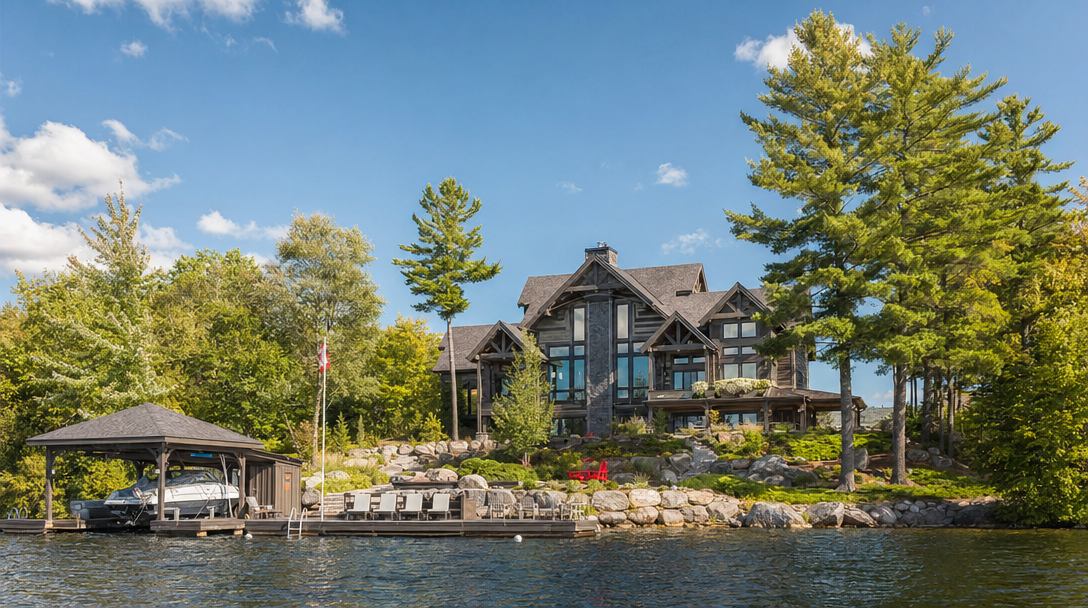
Muskoka cottage prices in 2026: the quick reality check buyers need first
The Muskoka cottage market is not in freefall, and it is not roaring either. That middle-ground reality shapes almost every pricing conversation a buyer needs to have in 2026.
Sales volume in 2026 edged up to 561 units — a modest 1.4% increase over 2026 — which signals a market that has stabilized without fully rebounding (Source: findingyourmuskoka.ca). Nationally, the median price of single-family recreational properties is forecast to rise by 4% in 2026, driven partly by constrained supply rather than surging demand (Source: Financial Post). In Muskoka, that supply tightness is real: quality waterfront listings are not hitting the market in large volumes, and when they do, well-positioned properties are not sitting long.
What does this mean practically? Buyers have more time and more choice than they did in 2021 or 2022, but they should not mistake a calmer market for a buyer's market with soft prices across the board. The entry-level and mid-range segments have seen some softening. The premium waterfront segment has not.
Three things buyers can say with confidence going into 2026:
- Negotiating room exists on the right properties — particularly older, less-updated, or seasonally accessible cottages
- Waterfront properties on the Big Three lakes (Muskoka, Rosseau, Joseph) remain price-resilient
- Buyers who wait for a broad correction in premium waterfront are likely waiting for something that will not arrive
The smarter approach is not to time the market but to understand which slice of the market you are actually competing in, then price accordingly.
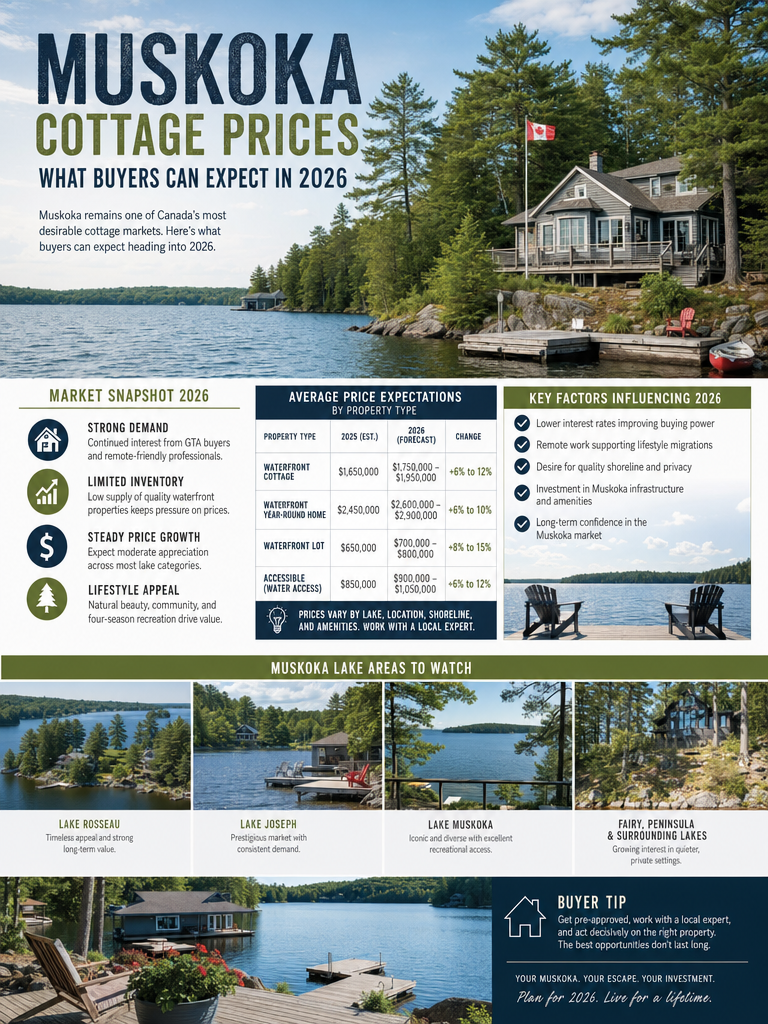
Where prices are holding strongest in 2026
Premium waterfront is the most defensible segment of the Muskoka market right now, and the gap between it and everything else is widening.
The 2026 luxury outlook points toward what analysts have called a "flight to quality" dynamic — where discretionary buyers, rather than chasing volume, are concentrating demand on a smaller pool of exceptional properties (Source: muskokacottagelistings.com). This means trophy waterfront homes with deep lots, hard-bottom swimming, south or west exposure, and year-round road access are commanding strong prices even when the broader market is quiet.
A well-positioned waterfront property on a prestige lake in Muskoka has never needed a hot market to hold its value — the scarcity does that work.
The practical split looks roughly like this:
| Segment | 2026 Price Direction | Negotiating Room |
|---|---|---|
| Premium waterfront, Big Three lakes | Holding firm / modest gains | Limited on quality listings |
| Mid-range waterfront, secondary lakes | Stable to slight softening | Moderate |
| Seasonal / limited-access cottages | Soft | More flexible |
| Off-water properties | Softer, more negotiable | Widest |
| Turnkey year-round waterfront | Strongest demand | Minimal on best examples |
For buyers targeting the luxury end, the lesson is clear: waiting for price relief in that tier has a real opportunity cost. For buyers working with a tighter budget or more flexibility on property type, 2026 genuinely offers more room to negotiate than the prior few years did.
Waterfront vs off-water: how much price gap really changes the decision
The price difference between a waterfront and off-water cottage in Muskoka can easily be $500,000 to $1,000,000 or more, depending on the lake and property. That gap is large enough to change how buyers should think about the decision entirely — not just as a price question, but as a lifestyle and resale question.
Waterfront ownership in Muskoka carries things off-water simply cannot replicate: the ability to swim, kayak, or take the boat out from your own dock, the evening light across the water, and the privacy buffer that a shoreline provides. These are not amenities — for most buyers, they are the entire reason Muskoka is the destination. Resale demand is also structurally different. Waterfront properties hold and grow value more consistently because supply is physically constrained.
Off-water properties offer a different kind of value. Deeded water access or shared-access rights can partially bridge the lifestyle gap. Buyers get significantly more square footage, more updated interiors, and more property for the same dollar. For families who want a cottage base without anchoring the entire budget to the water's edge, off-water can be a rational choice.
Where it gets complicated is resale. Off-water cottages appeal to a narrower buyer pool when it comes time to sell, and they appreciate more slowly. That is not a reason to avoid them, but it is a reason to be honest about your holding timeline and what you actually want from the experience.
The real decision is not price alone — it is what you are going to do with the property every weekend.
Why one Muskoka cottage can be priced far above another on the same lake
Two listings on the same lake, half a kilometre apart, can be priced $800,000 apart and both can be reasonably priced. This is one of the features of Muskoka that confuses outside buyers most.
The drivers of that gap are highly specific:
Shoreline type and frontage Hard-bottom, sandy-entry shoreline suitable for swimming is genuinely scarce. Rocky, shallow, or weed-heavy frontage reduces both practical enjoyment and buyer demand. More linear feet of frontage directly increases privacy and value.
Exposure and light South and west-facing lots capture afternoon and evening sun — the hours when most people are actually outside. North-facing lots can feel darker and cooler, particularly in shoulder seasons.
Year-round road access A municipally maintained road changes the property's usability and its financing profile. Seasonal or private road access limits who can use it, who can finance it, and what it costs to maintain.
Privacy and lot depth Deep, treed lots create natural screening from neighbouring properties and passing boats. Shallow lots or those close to marinas or public launches carry a meaningful discount for many buyers.
Winterization and building condition A well-insulated, year-round-ready cottage commands a premium over a three-season structure requiring significant investment before it can be used comfortably beyond Labour Day.
Terrain and dockage Flat lots that allow level access to the water are easier and cheaper to maintain. Steep terrain can mean expensive retaining walls, challenging dock access, and limited usability for older visitors. A quality, permitted dock adds real value.
Understanding these factors lets buyers evaluate asking prices as locally grounded judgements rather than arbitrary numbers.
Lake-by-lake and town-by-town pricing: what buyers should compare before they shop
Muskoka is not one market. The three prestige lakes — Rosseau, Joseph, and Muskoka — anchor the top of the pricing hierarchy and have historically held value most reliably. Lake Rosseau in particular sits at the premium luxury end, with waterfront properties ranging from $1M to $10M+ depending on the site (Source: kristynkennedy.com).
Secondary lakes like Lake of Bays, Three Mile Lake, Peninsula Lake, and Mary Lake offer meaningfully lower entry points without sacrificing the Muskoka experience. These lakes attract buyers who want genuine waterfront at a more accessible price and are often more open to negotiation in the current environment.
Town proximity matters too. Gravenhurst, Bracebridge, and Huntsville each have distinct personalities and different buyer profiles. Gravenhurst is the southernmost entry point from the GTA and appeals to buyers who want shorter drive times. Huntsville attracts buyers who want a fuller year-round infrastructure with ski access at Hidden Valley. Bracebridge sits in the middle of the district with practical access to all three prestige lakes.
For a deeper comparison of the top lakes, the [Top Muskoka Lakes for New Cottage Owners in 2026](/best-muskoka-lakes-new-cottage-owners) guide breaks down access, costs, and buyer fit in more detail. If the Big Three interest you specifically, the [Lake Muskoka vs Lake Rosseau buyer's guide](/lake-muskoka-vs-lake-rosseau-buyers-guide) lays out the tradeoffs directly.
When to buy in 2026: timing, seasonality, and negotiating room
Seasonal timing in Muskoka is genuinely meaningful, unlike in most urban markets where the calendar matters less.
Spring (April–May) brings the most competition. Motivated buyers return to the market after winter, inventory starts to list, and well-priced waterfront moves quickly. This is when urgency is highest and negotiating room is smallest on desirable properties.
Summer (June–August) is the emotional peak of cottage buying — and that emotion is expensive. Buyers fall in love with properties at their best, competition is intense, and sellers know it. Inspections are harder to schedule and conditions are more likely to be waived in competitive situations.
Fall (September–October) is often the most rational buying window. The cottage experience has cooled emotionally, serious sellers who didn't move in summer are open to real negotiation, and buyers have more time for thorough due diligence including [cottage inspections](/cottage-inspection-key-factors) and septic assessments.
Winter offers the widest negotiating room but the least inventory and the hardest conditions for proper inspection. Septic fields and docks are inaccessible; road conditions can make site visits impractical.
For most GTA buyers, fall is the underused window — more inventory is genuinely available, sellers are motivated, and a thoughtful offer with reasonable conditions is far more likely to be accepted.
Buyer checklist: how to judge whether a Muskoka cottage is priced fairly
Generic price-per-square-foot comparisons rarely work in Muskoka. Property-level judgment does.
- Compare recent sales on the same lake, not just the same town or region. Sales from the past 12 months on comparable frontage and condition are the most relevant benchmark.
- Assess the shoreline directly. Water depth, bottom quality, swimming access, and dock condition should be evaluated in person, not assumed from listing photos.
- Verify road access and maintenance. Ask explicitly whether the road is municipally maintained or privately managed — and who pays what.
- Confirm year-round usability. Understand what it would cost to winterize or upgrade the heating system if the listing is seasonal only.
- Look at days on market. A listing that has sat for 90+ days in peak season almost always has a specific reason — and that reason is worth understanding before interpreting the price as a deal.
- Budget for what comes after the purchase price. A fair market price for a property with an aging septic system is not the same as a fair price for a property with a recently replaced one.
A [Muskoka cottage inspection](/cottage-inspection-key-factors) is not optional on a purchase of this size — it is the single most important tool you have for validating what you are actually buying.
Budget beyond the purchase price: the costs that change affordability fast
The purchase price is only the beginning. Muskoka cottage ownership layers on costs that buyers from urban markets are often not accounting for.
Closing costs on a cottage purchase include land transfer tax, legal fees, title insurance, and potentially HST if the property is classified as a new build or has been used as a short-term rental. For a more complete breakdown, the [Muskoka cottage closing costs guide](/muskoka-cottage-closing-costs-what-buyers-should-budget-for) covers each line item specifically.
Beyond closing, the ongoing and one-time costs that change affordability calculations include:
- Septic systems: Replacement runs $15,000–$30,000 depending on terrain and soil conditions, and aging systems on older properties are common. See the [Muskoka septic guide](/muskoka-cottages-septic-issues) for what to look for.
- Dock maintenance and permitting: A quality permitted dock adds value, but repairs and seasonal installation/removal add up annually.
- Road maintenance fees: Private road associations can levy annual fees ranging from a few hundred to several thousand dollars.
- Cottage insurance: Waterfront properties, particularly seasonal-use or older structures, carry meaningfully higher premiums than primary residences.
- Winterization or heating upgrades: Converting a three-season cottage to year-round use can run $20,000–$60,000+ depending on insulation, heating system, and structural condition.
None of these costs make Muskoka cottage ownership impractical — but ignoring them makes the true affordability of any specific property genuinely misleading.
Edge cases that distort Muskoka pricing expectations
The cases where broad market averages mislead buyers most are the ones worth flagging directly.
Turnkey vs. fixer-upper: A well-renovated, move-in-ready cottage will price at a significant premium over a structurally similar property that needs work. That premium is often rational — renovation costs in Muskoka are higher than in urban markets due to contractor availability, material transport, and permitting timelines. The [turnkey vs. fixer-upper comparison](/turnkey-vs-fixer-upper-choosing-right-cottage) lays out where the economics actually make sense for each type of buyer.
Aging septic on otherwise attractive properties: A cottage with a great location, good frontage, and strong bones but an aging or non-compliant septic system requires a significant pricing discount to reflect replacement costs and the regulatory risk. Buyers should not assume sellers have priced this in.
Limited seasonal access: Cottages reachable only by private seasonal roads, water access only, or long unplowed lanes are priced lower for a reason. That lower price comes with real operational friction that is easy to underestimate until you are trying to reach the property in April mud season or after a November snowfall.
Trophy properties: At the extreme top end of the market, properties are priced on uniqueness rather than comparables. A one-of-a-kind waterfront compound on Lake Rosseau or Joseph does not have a direct comparable — and should not be evaluated as though it does.
In all these edge cases, the property-level story matters more than the market average. This is where local judgment earns its value.
When local guidance matters most in a Muskoka price decision
Market data tells you the direction. Local knowledge tells you whether the specific property in front of you is worth the number on the listing.
The cases where that distinction is most expensive to get wrong are exactly the ones that look straightforward from a distance: the cottage priced below market that has a shoreline issue, the waterfront listing that has been relisted three times, the property where the access road becomes impassable in spring. These details do not appear in listing descriptions and do not show up in price histories.
Seth lives and invests in Muskoka. That means the lake-by-lake pricing patterns, the specific shorelines, the seasonal road conditions, and the renovation realities are not abstractions — they are the working context for every property conversation.
If you are evaluating a specific property or trying to understand whether a lake or price point actually fits your budget and lifestyle, talking to someone who knows the ground is the most practical step you can take. Reach out directly to talk through what you are looking at.
Frequently asked questions
What is a realistic budget for a waterfront cottage in Muskoka in 2026?
Entry points vary significantly by lake — secondary lakes like Lake of Bays or Peninsula Lake can offer waterfront properties below $1M, while the Big Three (Muskoka, Rosseau, Joseph) typically start closer to $1M and run well above $10M for premium sites. The specific shoreline, road access, and condition of the property matter as much as the lake name when judging whether a price is realistic for your budget.
Are Muskoka cottage prices going to drop in 2026?
A broad price correction in premium waterfront is unlikely — constrained supply and concentrated demand among quality-focused buyers are keeping that segment firm. Softer pricing does exist in the seasonal, limited-access, and off-water segments, so there is negotiating room in certain parts of the market, just not evenly across all property types.
How much does it actually cost to own a Muskoka cottage beyond the purchase price?
Ownership costs that catch buyers off-guard include septic replacement ($15,000–$30,000 for aging systems), annual dock maintenance, private road association fees, higher insurance premiums for waterfront or seasonal structures, and winterization upgrades that can run $20,000–$60,000 or more if you want year-round use — none of which are reflected in the listing price.
Is fall really the best time to buy a Muskoka cottage, or is that just a myth?
Fall (September–October) is genuinely underused by buyers — sellers who didn't move in summer are more motivated, emotional competition has cooled, and you have more time for thorough due diligence like septic assessments and inspections. The tradeoff is slightly less inventory than spring, but the negotiating conditions are often more favorable for thoughtful buyers.
Why would two cottages on the same lake be priced hundreds of thousands of dollars apart?
The gap usually comes down to a handful of property-specific factors: shoreline quality (hard-bottom sandy swimming versus rocky or weedy), sun exposure (south and west-facing lots capture the hours people actually use), year-round versus seasonal road access, lot depth and privacy, and building condition — a well-winterized turnkey cottage commands a real premium over a three-season structure needing work.
Can I get a mortgage on a Muskoka cottage, or do financing rules work differently than a home purchase?
Financing a Muskoka cottage is possible but has more conditions than a primary residence — lenders look closely at year-round road access, whether the property has a potable water source, and whether it's a seasonal or permanent structure, since these affect insurability and lending terms. Properties with seasonal or water-access-only entry can be harder to finance through standard channels, which is one reason they tend to sell at a discount.
Sources
- Muskoka Cottage Market | 2026 Review & 2026 Forecastfindingyourmuskoka.ca
- 2026 Muskoka Luxury Waterfront Market Outlook - The Janssen Groupmuskokacottagelistings.com
- Cottage prices expected to rise this year as supply stays tightfinancialpost.com
- Is 2026 the Year to Buy Your Muskoka Cottage? Complete Guidewww.kristynkennedy.com
- Why Cottage Prices Aren't Dropping in 2026 - YouTubewww.youtube.com
- Muskoka Real Estate | Q1 2026 Statistics for Homes & Cottagesfindingyourmuskoka.ca
- Lake Joseph Waterfront Cottage Prices 2026 Guidebuymuskoka.com