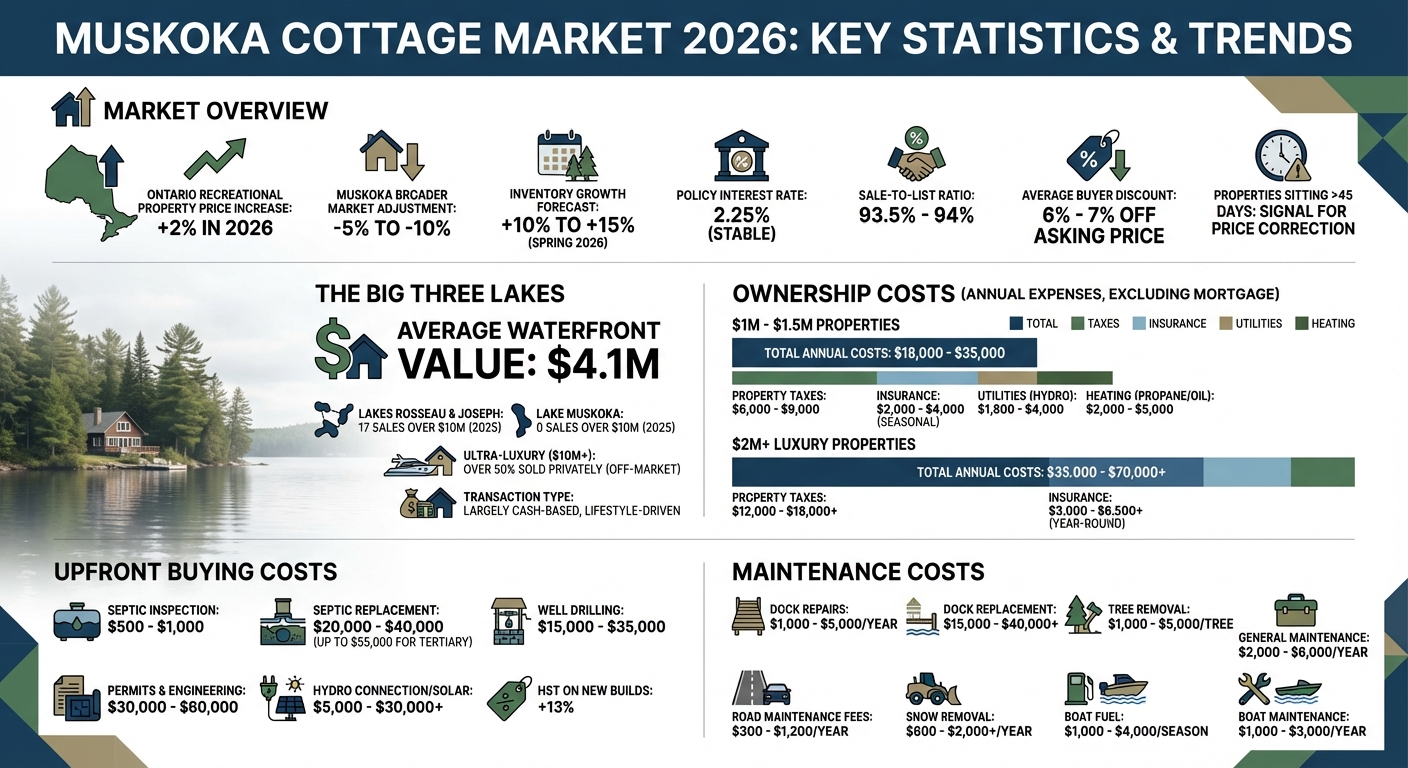
Muskoka’s cottage market in 2026 is calmer and more balanced than the pandemic years. Buyers are prioritizing high-quality, move-in-ready properties, while sellers must adjust to realistic pricing. Inventory is set to grow by 10%–15% this spring, giving buyers more choice and negotiating power. Interest rates remain stable at 2.25%, creating a predictable financing environment.
Key points:
- Ontario recreational property prices: Expected to rise 2% in 2026.
- Muskoka’s "Big Three" lakes: Average waterfront property value is $4.1M.
- Luxury properties: $10M+ homes on Lakes Rosseau and Joseph remain strong, with over half selling privately.
- Market shift: Older, three-season cottages are slower to sell, while turnkey, winterized homes with modern amenities still command high demand.
- Ownership costs: Annual expenses for $1M–$1.5M cottages range from $18,000–$35,000, while luxury homes over $2M can exceed $70,000.
The market rewards careful decision-making and local expertise, especially for high-end or off-market opportunities.
Muskoka Cottage Market 2026: Prices, Costs & Regional Trends
2026 Market Trends and Price Forecasts
Market Stabilization After Pandemic Volatility
The Muskoka cottage market has transitioned from the unpredictable "pandemic premium" era to a more steady and predictable rhythm. The market correction is now complete, and buyers are approaching purchases more deliberately, focusing on properties with enduring value rather than rushing into deals.
"The pandemic premium has fully corrected, and buyers have shifted decisively into a 'Flight to Quality' mindset."
– Jack Janssen, The Janssen Group [3]
Gone are the days of intense bidding wars that pushed property prices to unprecedented heights. Now, homes that remain on the market for over 45 days are often seen as overpriced or having issues, leading buyers to negotiate price reductions [3]. With sale-to-list ratios hovering between 93.5% and 94%, buyers are generally securing discounts of 6% to 7% off asking prices [3]. Additionally, a steady policy rate of 2.25% has contributed to a more stable financing environment [3].
This newfound stability lays the groundwork for varied price trends across regions.
Median Price Forecasts by Region
Ontario's recreational property market is projected to see modest growth in 2026, with a 2% increase following a nearly flat 0.4% rise in 2026 [1]. However, Muskoka's market tells a more nuanced story, with performance varying significantly depending on location and property condition.
The "Big Three" lakes in Muskoka - Muskoka, Rosseau, and Joseph - continue to stand out. These lakes maintain strong average waterfront property values of approximately $4.1 million [3]. Often considered generational assets, these properties are rarely sold outside family ownership. In 2026, Lakes Rosseau and Joseph saw 17 sales exceeding $10 million, while Lake Muskoka had none in this category [3]. This highlights a concentrated demand for ultra-luxury properties on select lakes.
In contrast, the broader Muskoka market is expected to see a decline of 5% to 10% in 2026 as it continues to adjust from the rapid price increases experienced during the pandemic [3]. Properties that aren't in turnkey condition may sit on the market longer, giving buyers more leverage to negotiate favourable deals. Inventory levels are also forecasted to rise by 10% to 15% this spring, offering buyers more choices than they've had in the past five years [3].
sbb-itb-3828479
What Drives Muskoka Cottage Prices in 2026
Inventory Levels and Supply
The Muskoka real estate market is seeing its most balanced conditions in five years, with inventory expected to increase by 10% to 15% this spring compared to 2026 [3]. This shift has changed how buyers approach the market. With more options available, buyers now have the time to carefully evaluate properties instead of rushing into decisions, a stark contrast to the frenzied pace of the pandemic years.
This increased supply has given buyers more leverage in negotiations, with many securing discounts of 6% to 7% off asking prices. However, not every property benefits equally from this trend. Turn-key, winterized cottages with modern amenities are still selling quickly and sometimes even attract multiple offers. On the other hand, older three-season properties tend to linger on the market unless they are priced aggressively.
"If a property sits longer than 45 days, buyers assume a flaw - or a price correction on the horizon."
– Jack Janssen, The Janssen Group [3]
One category that remains largely unaffected by these trends is "unicorn" properties - those rare listings with exceptional land, modern infrastructure, and prime exposure. These continue to fetch premium prices, even with higher inventory levels [3][1]. Meanwhile, the "Big Three" lakes maintain their reputation as generational assets, with waterfront properties holding steady at an average value of $4.1 million [3].
As inventory rises, stable financing conditions are also playing a key role in shaping buyer behaviour.
Interest Rates and Affordability
The stable financing environment in 2026 is another factor influencing the Muskoka market. With the Bank of Canada's policy rate steady at 2.25%, there hasn’t been a resurgence of frenzied buying. Instead, buyers are approaching purchases with greater caution, focusing on long-term fundamentals rather than acting out of urgency.
The market is becoming more segmented. For example, the ultra-luxury segment - properties priced above $10 million - remains largely unaffected by interest rate changes. These transactions are typically cash-based and driven by lifestyle choices [3].
"Properties above $10 million are largely insulated from interest rate movements because these transactions are typically cash-based and lifestyle-driven."
– Jack Janssen, The Janssen Group [3]
At the same time, mortgage renewals are reshaping the supply side. Some homeowners are facing higher carrying costs as their mortgages renew at rates above their original pandemic-era terms. This has prompted some to list their properties, occasionally at prices below what they originally paid [1][5]. This dynamic has contributed to the rise in inventory, creating opportunities for buyers looking for value.
Economic Conditions and Lifestyle Changes
Beyond financing, broader economic factors and changing lifestyle preferences are influencing the Muskoka market in 2026. Buyers are now prioritizing long-term value and generational assets rather than chasing quick speculative gains [3]. This marks a clear shift from the urgency that defined the pandemic years.
Muskoka’s transformation into a year-round destination continues to drive demand, particularly among high-net-worth individuals who see waterfront estates as primary or co-primary residences. This has increased interest in properties with four-season infrastructure, high-speed fibre internet, and wellness amenities like saunas and gyms [3]. While about 35% of realtors have noticed a trend of some residents returning to urban centres due to office mandates, this hasn’t significantly impacted Muskoka’s appeal as the "Hamptons of the North" [1].
"Concerns about the state of global affairs are certainly on the minds of many Canadians right now... and are tempering demand in parts of the country."
– Phil Soper, CEO, Royal LePage [1]
Economic uncertainty has also made buyers more selective and research-driven. Instead of casually browsing online, many are turning to local experts to help them find properties that meet specific criteria. Inflation and employment concerns are influencing decisions as well, but the extent of this impact varies widely across different price points [1].
Luxury Waterfront Properties: A Closer Look
The luxury waterfront market in Muskoka operates on a different wavelength compared to the broader real estate market. This segment benefits from steady demand and unique buyer preferences, making it a fascinating niche to explore.
Price Stability in the High-End Market
In Muskoka, properties priced at $3 million and above - especially those on the "Big Three" lakes (Rosseau, Joseph, and Muskoka) - are maintaining their value. While the wider Muskoka market might experience a 5% to 10% decline by 2026, these high-end properties are holding strong at an average waterfront value of $4.1 million. For many high-net-worth buyers, these estates are seen as generational investments rather than just real estate purchases [3].
The ultra-luxury category, which includes properties priced over $10 million, is even more resilient. Demand for these exclusive estates remains consistent, with over half of sales happening privately, bypassing the MLS entirely [3]. Many of these transactions are cash-based and largely unaffected by interest rate changes, as lifestyle considerations drive these purchases [3].
"Scarcity provides price stability, even when buyers are feeling cautious."
– Phil Soper, CEO, Royal LePage [1]
In this ultra-luxury tier, sale-to-list ratios remain stable. Buyers can usually negotiate discounts of about 6% to 7%, although truly exceptional "unicorn" properties - those with one-of-a-kind features - often sell closer to the asking price [3]. These dynamics highlight the specific elements that justify a premium in this market.
Features That Command Premium Prices
What sets a $4 million property apart from a $10 million one? It often comes down to privacy and exclusivity. Buyers are willing to pay a premium for long shorelines, natural screening, and controlled sightlines that create a sense of seclusion - a feature often described as a "discreet playground" [2].
"Privacy-driven design commands a premium... Long shorelines, natural screening, and controlled sightlines consistently outperform flashier features over time."
– Jeffrey Braun [2]
Turn-key properties are also in high demand. With construction timelines stretching and permits taking longer, buyers are willing to pay more to avoid the hassle of renovations [3][4]. Four-season infrastructure is another key selling point. Features like winterization, year-round road access, and high-speed fibre internet are increasingly important as more buyers view these estates as co-primary residences rather than just seasonal retreats [2][3]. Additionally, properties with south-to-northwest exposure and gentle slopes for easy water access are especially coveted [3].
Wellness amenities are becoming a must-have in the luxury segment. Features like saunas, professional-grade home gyms, and cold plunges are now expected, reflecting a shift toward using these properties as year-round homes rather than occasional escapes [3].
Total Ownership Costs in 2026
Owning a Muskoka cottage involves much more than just the purchase price. While many buyers focus on securing a mortgage, it's easy to overlook the ongoing expenses tied to waterfront living. By 2026, these costs have become somewhat predictable, but they remain significant enough to require careful budgeting. To truly understand the financial commitment, it's essential to factor in these additional expenses.
Additional Buying Expenses
Before you even get the keys to your new cottage, there are upfront costs to consider. For example, a professional septic inspection typically runs between CA$500 and CA$1,000. If a full septic system replacement is needed, costs can range from CA$20,000 to CA$40,000, with tertiary systems for sensitive shorelines exceeding CA$55,000.
If you're buying vacant land or planning major developments, prepare for additional fees. These include:
- Permits and engineering studies: CA$30,000 to CA$60,000
- Well drilling: CA$15,000 to CA$35,000
- Septic installation: CA$25,000 to CA$50,000
- Connecting to hydro or installing off-grid solar: CA$5,000 to over CA$30,000
For new builds, an extra 13% HST applies, though rebates may be available in certain cases [6][7].
Recurring Costs and Maintenance
Once you're settled, the ongoing costs of cottage ownership can be substantial. For a property valued between CA$1 million and CA$1.5 million, annual expenses (excluding the mortgage) typically range from CA$18,000 to CA$35,000. For luxury properties over CA$2 million, these costs can climb to CA$35,000 to CA$70,000 or more.
Property taxes are often the largest fixed cost. A CA$1 million waterfront cottage usually incurs annual taxes of CA$6,000 to CA$9,000, while luxury homes valued at CA$2 million or more face taxes ranging from CA$12,000 to over CA$18,000. Properties on Muskoka, Rosseau, and Joseph lakes tend to have higher assessments, while riverfront or smaller lake properties often see 10%–25% lower taxes.
Insurance premiums vary depending on the property and its use. Seasonal cottages typically cost CA$2,000 to CA$4,000 annually, while year-round homes range from CA$3,000 to CA$6,500 or more. Proximity to fire services, water source, and features like wood stoves all influence rates.
Utilities and infrastructure are another key expense. Annual hydro costs range from CA$1,800 to CA$4,000, and heating with propane or oil adds CA$2,000 to CA$5,000. Other recurring costs include:
- Water treatment maintenance: CA$300 to CA$1,000
- Generator servicing: CA$300 to CA$800
Since most Muskoka properties rely on private infrastructure, these costs are unavoidable.
Shoreline and dock maintenance can also add up. Dock repairs cost CA$1,000 to CA$5,000 annually, with fall removal and storage adding CA$800 to CA$2,000. Replacing a dock system can cost anywhere from CA$15,000 to CA$40,000 or more. Septic systems require pumping every three to five years, costing CA$400 to CA$600 per service.
Property maintenance includes everything from tree removal (CA$1,000 to CA$5,000 per tree) to general upkeep (CA$2,000 to CA$6,000 annually). If your property is on a private or shared road, expect road maintenance fees of CA$300 to CA$1,200 annually and snow removal costs of CA$600 to CA$2,000 or more.
Lifestyle expenses are another factor. Boat fuel can cost between CA$1,000 and CA$4,000 per season, with maintenance adding another CA$1,000 to CA$3,000 annually. Boat insurance typically ranges from CA$300 to CA$1,200 per vessel [6].
"Waterfront ownership - especially here in Muskoka - isn't just about qualifying for the mortgage. It's about understanding what it truly costs to live well on the water… in all four seasons."
– Lisa Selvage, Agent [6]
Modern cottages built in 2026 are generally more energy-efficient and easier to maintain than older properties from the 1970s, which often come with higher heating and upkeep costs. By planning realistically, owning a Muskoka cottage can be both enjoyable and manageable [6]. These ongoing costs, combined with purchase prices, give buyers a complete understanding of what it takes to own a piece of Muskoka.
Price Differences Across Muskoka Regions
Building on earlier market trends, it's clear that regional differences significantly shape property prices in Muskoka. While the region as a whole is known for its premium waterfront properties, not all lakes are equal in terms of value. Understanding these variations is crucial for making informed decisions in 2026. Factors like location, property features, and market dynamics all contribute to the price differences between lakes.
Pricing Trends by Lake
The "Big Three" lakes - Muskoka, Rosseau, and Joseph - continue to dominate the market, maintaining strong demand and stable waterfront values [3]. However, even among these sought-after lakes, there are noticeable differences.
Lake Joseph consistently leads the ultra-luxury market, offering deep water, expansive lots, and private estates that appeal to high-net-worth buyers. In 2026, Lakes Rosseau and Joseph accounted for over half of ultra-luxury sales, many of which occurred off-market [3]. On the other hand, Lake Muskoka, while popular for family retreats, has seen fewer ultra-luxury transactions recently [3].
"The pandemic premium has fully corrected, and buyers are now entering a Flight to Quality era - one defined by selectivity, long‑term value, and a return to fundamentals."
– Jack Janssen, The Janssen Group [3]
Lake Rosseau strikes a balance between prestige and practicality, offering proximity to villages like Port Carling, which adds convenience for buyers [2]. Meanwhile, Lake Muskoka is increasingly favoured for long-term family use and multi-generational cottages, rather than as a focus for ultra-luxury investments [2].
Outside the Big Three, smaller or more peripheral lakes may see a 5% to 10% price adjustment as the market continues to stabilize [3]. While these areas can offer great value, they lack the scarcity that drives higher prices on the Big Three lakes.
Property features also play a key role in pricing. Turn-key, winterized cottages with south-to-northwest exposure and gentle terrain tend to sell quickly and at premium prices. In contrast, older three-season cottages or properties with steep, north-facing lots often need significant price reductions to attract buyers [3]. Currently, the sale-to-list price ratio ranges between 93.5% and 94%, meaning buyers can often negotiate 6% to 7% off the asking price - except for rare, highly desirable "unicorn" properties [3].
Using Comparable Sales Data
To fully understand these regional differences, it’s important to look beyond online listings and examine comparable sales data. This is especially true for Muskoka, where over 50% of CA$10 million-plus sales on Lakes Rosseau and Joseph happen off-market or through private trusts [3]. As a result, publicly available data only provides part of the picture, making local expertise invaluable.
Comparable sales data can help establish fair market value, but context is key. Properties that remain on the market for over 45 days often signal the need for price adjustments [3]. Inventory in the Muskoka region is expected to increase by 10% to 15% in spring 2026, giving buyers more options and negotiating power [3].
When evaluating properties, focus on unchangeable factors like land quality, privacy, water frontage, and exposure. Modern upgrades can always be added later, but these core elements are what truly drive long-term value [3]. Working with professionals who have access to off-market data and a deep understanding of the area ensures you’re making decisions based on a complete picture, not just what’s visible on the MLS.
Conclusion: What to Know About 2026 Muskoka Cottage Prices
The Muskoka cottage market in 2026 shows signs of stabilizing, with buyers focusing more on long-term value than rushing into purchases. The frenzied demand seen during the pandemic has settled, giving way to a more selective and balanced approach.
In Ontario, recreational property prices are expected to increase by a modest 2% this year[1]. The Big Three lakes - Rosseau, Joseph, and Muskoka - continue to hold their reputation as prime locations, with average waterfront property values sitting at roughly $4.1 million. These lakes remain a draw for high-net-worth individuals seeking generational investments[3].
Spring inventory is anticipated to grow by 10%–15%, creating the most balanced market conditions in five years. With the policy interest rate at 2.25%, buyers have an opportunity to find discounts on non-premium properties[3]. However, turnkey, winterized cottages with modern systems and favourable exposure are still in high demand and command top dollar. In contrast, older three-season cottages or properties with challenging terrain often linger on the market and may see price reductions[3].
Regional trends also highlight key differences. In 2026, Lakes Rosseau and Joseph recorded 17 sales exceeding $10 million, while Lake Muskoka saw none in this bracket[3]. These variations emphasize the need for precise local knowledge when navigating the market.
"Buyers increasingly turned to trusted local experts for guidance rather than relying on out‑of‑town agents or broad online browsing. In a more selective environment, on‑the‑ground expertise became a decisive advantage."
– The Janssen Group[3]
As 2026 unfolds, the Muskoka market rewards those who prioritize careful decision-making and rely on local expertise. Whether you're looking to buy, sell, or invest, working with professionals like Seth Drabinsky Realty can open doors to exclusive off-market opportunities and provide insights into strategic pricing. With over 50% of $10 million-plus sales occurring privately in 2026, having a trusted local expert is more important than ever[3].
FAQs
Will Muskoka cottage prices drop in 2026?
Muskoka's cottage prices are expected to rise by about 4% in 2026. This trend is largely driven by a combination of limited supply and strong, consistent demand in the area. For buyers and investors, this means it's crucial to anticipate and prepare for these market conditions, as they will likely continue to push prices higher.
How much can buyers negotiate off asking in 2026?
By 2026, buyers might have the chance to negotiate 5% to 10% off asking prices. With inventory levels predicted to rise, the market is likely to ease, giving buyers greater bargaining power. This shift could open the door for more advantageous deals for those looking to purchase Muskoka cottages.
What should I budget for yearly cottage ownership costs?
When budgeting for a cottage in Muskoka, you should allocate around $6,000 to $9,000 annually for property taxes. On top of that, don't forget to include expenses like insurance, seasonal maintenance, and other ownership-related costs to get a clear picture of the total yearly expenses.
Frequently Asked Questions
Is now a good time to buy a Muskoka cottage, or should I wait?
2026 is one of the more buyer-friendly windows in recent memory — inventory is up 10–15% from prior years, sale-to-list ratios sit around 93.5–94%, and stable interest rates mean you can evaluate properties without urgency. That said, truly turnkey waterfront properties on the Big Three lakes still attract strong interest, so timing depends heavily on which segment you're targeting. Talk to Seth to get a read on current conditions for the specific lake or property type you have in mind.
What's the real difference between Lake Joseph, Lake Rosseau, and Lake Muskoka in terms of price and buyer fit?
Lake Joseph consistently leads for ultra-luxury buyers, with deep water, large private estates, and a high share of off-market sales above $10 million. Lake Rosseau balances prestige with village access near Port Carling, making it appealing for buyers who want both exclusivity and convenience. Lake Muskoka tends to attract families and multi-generational buyers more than ultra-luxury investors, and has seen fewer $10M-plus transactions recently.
How do I find out about Muskoka cottages that never get listed publicly?
More than half of sales above $10 million on Lakes Rosseau and Joseph happen privately, through off-market networks and personal connections rather than public listings — which means browsing online only shows part of what's available. Working with a local specialist who has established relationships in the region is the most reliable way to access these opportunities before they reach a broader audience.
What ownership costs am I likely to underestimate when buying a Muskoka waterfront property?
Most buyers focus on the mortgage and property taxes, but shoreline and dock maintenance, septic servicing, private road upkeep, and seasonal utility costs add up significantly — often $18,000 to $35,000 annually for a $1M–$1.5M property, and well above $70,000 for luxury homes over $2M. Older three-season cottages can also carry higher heating and structural maintenance costs than newer builds, which is worth factoring into any price comparison.
What features actually hold their value best in Muskoka waterfront real estate?
The elements that consistently protect and grow long-term value are the ones you can't change after purchase: water frontage, lot privacy, south-to-northwest sun exposure, and gentle terrain for easy water access. Modern upgrades and amenities matter to buyers right now, but land quality and shoreline character are what drive resale premiums over time.